
There are people around the world who love to play games while there are others who prefer to build games. If you’re one of the people who enjoy and are passionate about making games, you’ve come to the right place.
Many developers in the game business prefer C++ to other programming languages. You have to choose the greatest if you want to produce or develop the finest.
Your path to success will be paved with a suitable gaming engine. Selecting a gaming engine is the first and most important stage in building a game. In this article, we will be talking about some of the most popular Game Engines For C++ to use.

Key Summary
Industry Leaders
- Unreal Engine (Epic Games) Cross-platform support (Windows, macOS, Linux, mobile, consoles) Advanced rendering, physics, audio, networking, and AI tools Blueprint visual scripting system Flexible licensing models
- Cross-platform support (Windows, macOS, Linux, mobile, consoles)
- Advanced rendering, physics, audio, networking, and AI tools
- Blueprint visual scripting system
- Flexible licensing models
- CryEngine (Crytek) Known for exceptional graphics and rendering Integrated Sandbox Editor with real-time editing Advanced physics and animation systems Multi-platform support, including VR
- Known for exceptional graphics and rendering
- Integrated Sandbox Editor with real-time editing
- Advanced physics and animation systems
- Multi-platform support, including VR
Popular Open-Source Options
- Godot Engine Open-source with 2D and 3D support Multiple language support (GDScript, C#, C++, VisualScript) Node-based architecture for easy organization Cross-platform export capabilities
- Open-source with 2D and 3D support
- Multiple language support (GDScript, C#, C++, VisualScript)
- Node-based architecture for easy organization
- Cross-platform export capabilities
- Open 3D Engine (O3DE) Developed by Linux Foundation with AWS, Adobe, Huawei Modular, extensible architecture Multi-threaded photorealistic renderer No licensing fees or commercial restrictions
- Developed by Linux Foundation with AWS, Adobe, Huawei
- Modular, extensible architecture
- Multi-threaded photorealistic renderer
- No licensing fees or commercial restrictions
- Urho3D Lightweight, free under MIT license Clean, well-commented codebase Cross-platform (Windows, Linux, macOS, mobile, Raspberry Pi) No royalties or vendor lock-ins
- Lightweight, free under MIT license
- Clean, well-commented codebase
- Cross-platform (Windows, Linux, macOS, mobile, Raspberry Pi)
- No royalties or vendor lock-ins
Specialized Engines
- Cocos2d Family of frameworks optimized for 2D graphics Multiple branches (Cocos2d-x for C++) Lightweight with high performance on various devices Rich 2D functionality (animations, physics, particles)
- Family of frameworks optimized for 2D graphics
- Multiple branches (Cocos2d-x for C++)
- Lightweight with high performance on various devices
- Rich 2D functionality (animations, physics, particles)
- Spring Engine Specialized for real-time strategy (RTS) games Open-source with strong physics simulation Highly modular and customizable Cross-platform support
- Specialized for real-time strategy (RTS) games
- Open-source with strong physics simulation
- Highly modular and customizable
- Cross-platform support
Performance-Focused
- WickedEngine Advanced open-source engine with high-fidelity graphics Modern graphics APIs for stunning visual effects Cross-platform design with scripting support Comprehensive toolset for development
- Advanced open-source engine with high-fidelity graphics
- Modern graphics APIs for stunning visual effects
- Cross-platform design with scripting support
- Comprehensive toolset for development
- Flax Engine Focus on performance, visual quality, and productivity. Cross-platform deployment Advanced rendering with DirectX 12 and Vulkan support Live editing for real-time adjustments
- Focus on performance, visual quality, and productivity.
- Cross-platform deployment
- Advanced rendering with DirectX 12 and Vulkan support
- Live editing for real-time adjustments
Learning & Development
- AppGameKit User-friendly for beginners and educators BASIC-like scripting language option Rapid prototyping capability Cross-platform deployment
- User-friendly for beginners and educators
- BASIC-like scripting language option
- Rapid prototyping capability
- Cross-platform deployment
- Leadwerks Designed for learning game development Straightforward tutorials for beginners Royalty-free license PC-focused development
- Designed for learning game development
- Straightforward tutorials for beginners
- Royalty-free license
- PC-focused development
Specialized & Niche
- Panda3D (Disney/Carnegie Mellon) Python-friendly approach Open-source and free Strong rendering capabilities Educational focus
- Python-friendly approach
- Open-source and free
- Strong rendering capabilities
- Educational focus
- X-Ray Engine Powers S.T.A.L.K.E.R. series Advanced physics and dynamic lighting Complex AI behaviors Atmospheric environment creation
- Powers S.T.A.L.K.E.R. series
- Advanced physics and dynamic lighting
- Complex AI behaviors
- Atmospheric environment creation
- Halley Game Engine Lightweight, written in C++17 Code-first approach (no editor dependency) Used in commercial games (Wargroove) Fast iteration time
- Lightweight, written in C++17
- Code-first approach (no editor dependency)
- Used in commercial games (Wargroove)
- Fast iteration time
Newer/Emerging Options
- Evergine (formerly Wave Engine) Entity-Component System architecture Comprehensive toolset Support for VR/AR technologies Professional visualizations and simulations
- Entity-Component System architecture
- Comprehensive toolset
- Support for VR/AR technologies
- Professional visualizations and simulations
- RavEngine C++20 cross-platform framework Parallel ECS for efficient querying Modern rendering APIs Advanced audio with 3D spatial support
- C++20 cross-platform framework
- Parallel ECS for efficient querying
- Modern rendering APIs
- Advanced audio with 3D spatial support
Best C++ Game Engines for Developers and Startups
1. Unreal Engine
Unreal Engine, developed by Epic Games, stands as a top game engine for C++, offering unparalleled support for a wide array of platforms including Windows, macOS, Linux, iOS, Android, and consoles.
Engineered to transform 3D game development, it also powers simulations and visual content in multiple industries. With an advanced architecture, it features high-performance rendering, a dynamic physics engine, and comprehensive audio, networking, and AI tools to meet varied development needs.
Accessibility is a key strength, with detailed documentation, a supportive community, and a well-stocked marketplace enhancing user experience. Game development is streamlined with Unreal Engine’s Blueprints visual scripting and user-friendly tools. Flexible licensing models promote broad use, securing its position as a foundational game engine.
2. Godot Engine
Godot is an open-source game development platform initially developed by Juan Linietsky and Ariel Manzur and later released in 2014. This C++ game engine empowers creators to build both 2D and 3D games. Godot supports scripting in GDScript, a Python-like language designed specifically for the engine, as well as C#, C++, and VisualScript, offering versatility for developers with different programming backgrounds.

Juan Linietsky (Left) and Ariel Manzur (Right)
Godot Engine is equipped with a full suite of tools for graphics, animation, audio, and physics, enabling the creation of detailed and attractive games independently. With its cross-platform support, games can be exported to a wide array of platforms such as Windows, macOS, Linux, iOS, Android, HTML5, and various consoles.
Moreover, structured around nodes and scenes, Godot’s design simplifies the organization and management of game elements. This, combined with its comprehensive toolset, renders Godot adaptable for any project size, from small indie endeavors to extensive commercial games.
3. Open 3D Engine (O3DE)
The Open 3D Engine was developed with C++ as the core programming language by the Linux Foundation together with 20 founding members. They include Amazon Web Services (AWS), Adobe, Huawei, Niantic, and Red Hat. This initiative was launched to foster developer collaboration on 3D engine development for a wide range of apps, from AAA games to high-fidelity simulations.
O3DE is used for creating interactive 3D content, offering developers a powerful, open-source alternative for building games, simulations, and other visual applications. Its architecture is designed to be modular and extensible, supporting a broad spectrum of development needs without licensing fees or commercial restrictions.
Microsoft OpenJDK Goes GA at Build – InApps 2022
Key aspects of this game engine for c++ include its cross-platform capabilities, allowing development across various operating systems. A multi-threaded photorealistic renderer for high-quality visuals. And a comprehensive suite of tools for asset creation, physics simulation, and animation. The engine aims to democratize 3D development, providing a community-driven platform for innovation and creativity in the digital content space.
4. Flax Engine
Developed with a focus on performance, visual quality, and productivity,
Flax Engine
is built primarily in C++ to offer developers robust tools for both 2D and 3D game development. Over the years, this game engine for C++ has evolved. Now it has gained attention for its streamlined workflow and the ease with which developers can deploy their games across multiple platforms.
Flax Engine is used to develop a variety of games, from indie titles to more complex projects. Its versatility also makes it suitable for non-gaming applications such as simulations, visualizations, and interactive media experiences.
Key features of Flax game engine:
- Cross-Platform Development: Offers broad platform support, enabling games to reach audiences on Windows, Linux, macOS, Xbox, PlayStation, and mobile devices.
- High-Quality Rendering: Features advanced rendering capabilities like real-time global illumination and physically based rendering (PBR), along with support for DirectX 12 and Vulkan APIs, for creating visually impressive games.
- Visual Scripting and C# Support: Provides flexibility with support for C++, C#, and visual scripting, facilitating quick prototyping and game logic development without deep coding, appealing to a wide range of developers.
- Live Editing allows for real-time in-game adjustments, drastically improving development efficiency by offering immediate feedback.
- Asset Management streamlines the organization, import, and management of a wide variety of asset types, enhancing productivity and reducing complications in asset handling.
5. Cocos2d
Cocos2d
is a family of open-source software frameworks used for developing interactive applications and games, primarily in the mobile space. It includes several branches, such as Cocos2d-x, Cocos2d-js, and Cocos2d-Swift, each targeting different platforms and programming languages. Cocos2d-x, using C++, is the most widely known and used among them, allowing for the development of games and apps that can run on iOS, Android, Windows, Mac, and web browsers.
Key Features:
- Efficiency for 2D Games: Cocos2d is optimized for 2D graphics, with a lightweight rendering system that provides high performance on both low-end and high-end devices.
- Rich Functionality, such as animations, physics integration, particle effects, and support for sprite sheet animations, making it capable of handling complex 2D game projects.
- Language Support: While Cocos2d-x focuses on C++, other branches like Cocos2d-js offer support for web development with JavaScript, and Cocos2d-Swift (formerly Cocos2d-iphone) caters to iOS development with Swift and Objective-C.
- Active Development and Extensibility: Continuous updates and active development ensure that Cocos2d stays relevant to the latest technological advancements. Its extensible architecture allows developers to integrate third-party libraries and tools to expand its capabilities.
6. CryEngine
CryEngine
is a powerful game engine in C++ designed for the development of high-quality video games across multiple platforms, including Windows, consoles, and VR. Developed by Crytek, CryEngine gained fame with “Far Cry” in 2004 and has since evolved, consistently advancing in visual quality, real-time graphics, and immersive experiences.

CryEngine supports diverse game types, including first-person shooters and open-world adventures, focusing on high-quality graphics and immersive gameplay. It’s also used in simulations, architectural visualizations, and VR, utilizing its graphics to produce a realistic environment.
Features of CryEngine:
- State-of-the-Art Graphics: CryEngine sets the industry standard with unparalleled graphics, excelling in lighting, shading, and rendering for lifelike environments and characters.
- Sandbox Editor: Offers an integrated development environment with real-time world editing capabilities, enhancing creativity and streamlining game development.
- Multi-Platform Support: Notably supports PC, consoles, and VR, enabling the creation of immersive experiences across a wide array of devices.
- Physics and Animation: Features a comprehensive physics engine and advanced animation tools for creating realistic interactions and movements within games.
7. Panda3D
Developed jointly by Disney’s VR Studio and Carnegie Mellon University’s Entertainment Technology Center, this game engine in C++
Panda3D
offers a flexible and powerful platform for game development and real-time 3D applications. Its Python-friendly approach makes it particularly suited for educational purposes and rapid prototyping, where ease of use and quick development cycles are prioritized.
Key Features of Panda3D:
- Open Source and Free: Panda3D is fully open-source, providing developers with the freedom to modify, extend, and customize the engine to fit their specific needs without any licensing fees.
- Cross-Platform Compatibility: It supports development for multiple platforms, including Windows, macOS, and Linux.
- Powerful Rendering Capabilities: Despite its ease of use, Panda3D does not compromise on performance and visual quality. It includes advanced rendering techniques, support for shaders, and a flexible scene graph.
- Python Integration: Panda3D offers a high-level programming interface that is easy to learn and use, making this game engine appealing to developers who prefer Python for rapid development and prototyping.
- C++ Support: For those needing the performance benefits of a lower-level language, Panda3D also provides a native C++ interface, giving developers the best of both worlds in terms of ease of use and performance.
8. Evergine
Evergine
, formerly known as Wave Engine, is a comprehensive and advanced 3D graphics engine designed for the development of cross-platform games, simulations, and visualizations. The rebranding from Wave Engine to Evergine signaled a broader ambition to support not just game development but also complex simulations and professional visualizations across industries.
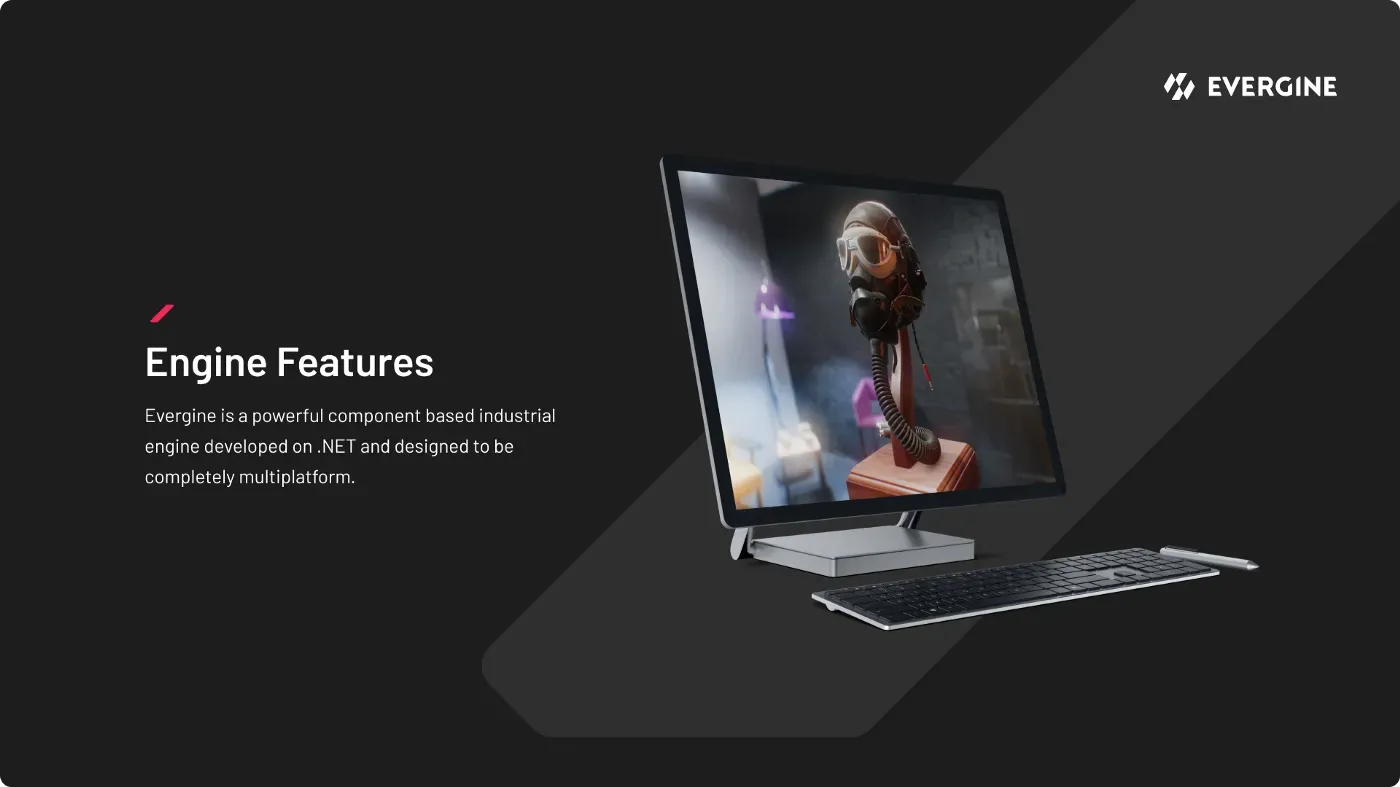
Evergine is utilized across a range of applications beyond traditional gaming. It caters to developers looking to create visually stunning and highly interactive 3D applications. This C++ game engine can render high-quality 3D graphics and support VR and AR technologies, making it a versatile choice for projects requiring immersive and interactive 3D experiences.
Key Features of Evergine
- Entity-Component System (ECS): Evergine adopts an ECS architecture, which enhances performance and scalability by separating logic and data. This system allows for more efficient processing of complex scenes and interactions within the engine.
- Comprehensive Toolset: The engine provides developers with a robust suite of tools for asset management, scene editing, and performance optimization. These integrated tools support a streamlined workflow from development to deployment.
- Community and Documentation: Evergine is supported by an active community and comprehensive documentation, including tutorials, guides, and API references. This wealth of resources aids developers in overcoming challenges and maximizing the engine’s potential.
It’s Beta Time For CoreOS, The Linux Distro For Massive Server Deployments – InApps 2022
9. Spring Engine
The
Spring Engine
is a powerful, open-source game engine in C++ primarily known for its robust support for real-time strategy (RTS) games. Beyond traditional RTS games, the Spring Engine has been used to create a variety of game types, showcasing its versatility. The engine’s open-source nature has enabled it to be adapted for different genres and custom projects.
Key features of Spring Engine
- Modularity and Customization enable developers to customize or replace almost any component of the engine.
- Physics and Simulation: The engine includes a comprehensive physics simulation, handling collisions, unit movements, and terrain interactions with high accuracy. This adds a layer of realism and strategic depth to games developed with Spring.
- Cross-Platform Support: Spring Engine supports multiple platforms, including Windows, Linux, and macOS.
- Graphics and Rendering: While primarily focused on gameplay mechanics, Spring Engine also offers competent graphics capabilities, with support for modern rendering techniques to create visually appealing RTS games.
10. WickedEngine
Wicked Engine
is an advanced, open-source C++ game engine renowned for its high-fidelity graphics and real-time rendering capabilities. It leverages modern graphics APIs to deliver stunning visual effects and detailed environments suitable for applications, from games to simulations.
Key features of WickedEngine
(besides high-fidelity graphics and real-time rendering):
- Being open-source, Wicked Engine encourages contributions and modifications from its community, making it a collaborative project that evolves with the input of its users.
- The engine is designed to be cross-platform
- While primarily a C++ engine, Wicked Engine supports scripting for game logic and automation, making it accessible to developers who prefer not to work directly with C++ for every aspect of development.
- Comprehensive Toolset including a scene editor and debugging tools, streamlines the development process and aids in the creation of complex scenes and game mechanics.
11. AppGameKit
As a user-friendly game engine in C++,
AppGameKit
is used by not only pro game developers, but also educators, and hobbyists to create a variety of games and interactive content. It emphasizes ease of use, rapid development, and cross-platform compatibility, so indie developers and educators can use it.
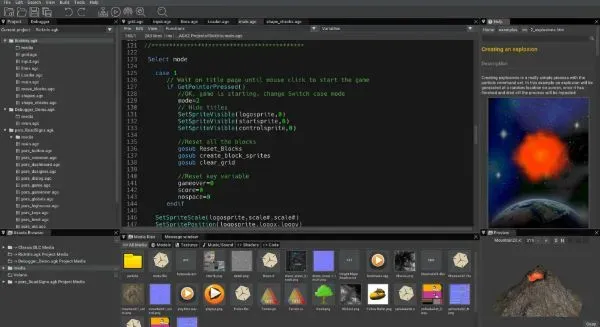
Appgamekit studio
Key Features
- AppGameKit can be deployed across iOS, Android, Windows, macOS, Linux, and HTML5.
- Easy to Learn: With its own BASIC-like scripting language, AppGameKit Classic offers an accessible entry point for beginners, while AppGameKit Studio provides a more advanced environment with additional features and support.
- Rapid Prototyping: Developers can quickly prototype and iterate on game ideas, thanks to the engine’s straightforward syntax and command set.
- AppGameKit includes various development tools and features, such as 2D and 3D graphics, physics, audio, and input device support, making complex and engaging games possible.
12. Enigma
Unlike other game engines, Enigma is not one, but it comprises an IDE, Compiler, and Game Engine in C++.
Enigma
is a game development environment that mimics the design and functionality of classic game creation tools. It emphasizes ease of use and compatibility. Leveraging a C++ backend, this game engine allows for the development of performance-oriented games that can run across various platforms.
What makes people love Enigma is its compatibility with games and applications created in older engines. This provides a modern pathway for updating and enhancing legacy projects.
Key features:
- It’s free and open source!
- Compiled for maximum speed, with lightning fast calculations!
- Easy to learn, and Game Maker compatible!
- It’s a great way to get started with C++.
13. ezEngine
ezEngine
is an open-source, highly modular game engine designed for simplicity and flexibility. This game engine primarily targets the development of PC and console games. Written in C++, it emphasizes ease of use for developers, offering a comprehensive set of tools for creating complex games and visual applications.
What makes ezEngine stand out is its focus on developer productivity, since it features a robust editor and support for rapid prototyping and iteration.
14. LumixEngine
LumixEngine is a lightweight, open-source 3D game engine built with a focus on performance and flexibility. Developed in C++, it aims to provide a user-friendly platform for indie developers and small teams to create high-quality games with minimal overhead.
LumixEngine features an intuitive entity-component system and supports a wide range of graphical and audio assets, so it’s a versatile choice for creating immersive game experiences.
15. AtomicGameEngine
Atomic Game Engine
is an open-source, cross-platform game development engine known for its versatility and ease of use. Supporting C++ and JavaScript, it caters to a broad spectrum of developers, from professionals to enthusiasts.
Atomic Game Engine is designed to facilitate the rapid development of games and interactive content. It offers robust 2D and 3D capabilities, comprehensive editor tools, and a modular architecture for maximum flexibility.
16. X-Ray Engine
X-Ray Engine is best known for powering the Chornobyl-based survival shooter series, S.T.A.L.K.E.R. Developed by GSC Game World, it features advanced physics, dynamic lighting, and complex AI behaviors, making it well-suited for creating immersive first-person shooters and survival games. The engine’s realistic environmental effects and detailed graphics emphasize its capability to produce highly engaging and atmospheric game worlds.

17. C4
C4 is an OpenGL-based game development engine written in C/C++. Terathon Software was created in 2005 and made it available for purchase to developers all over the world. It works with various game platforms, including Windows, OS X, PS4, PS3, and Linux.
Drupal’s Founder on Why Open Source Is Recession-Proof – InApps 2022
It’s used to make high-resolution 3D games for consoles and computers. The Gaming Engine can also produce dynamic virtual simulations, enabling developers to explore new dimensions and create incredible content.
The layered structure of software components makes up the C4 engine architecture. Lower layering is for hardware and OS, while the higher is for project-specific platform-independent services. While the 3D graphics and rendering system takes up most of the engine’s space. Audio, networking, physics, input devices, and scripting are all supported by some components.
Users can access the engine’s documentation through a collection of API web pages and a wiki. The engine’s licensing terms were re-defined in 2014, to increase revenue by making the licence subscription-based.
Features of C4
- C4 engine consists of OpenGL library for Windows, Mac, and Linux.
- The WAV audio format is supported by the engine, which uses 16-bit mono or stereo sampling. Sound from memory or disc can be played by the engine.
- A two-layer messaging system that uses the UDP protocol to communicate across various machines is utilized to allow multiplayer gaming.
- It also features a built-in physics engine that aids in the creation of games.
- The engine’s World Editor is a 3D asset creation application that allows you to build geometric objects, light, sound, and various effects.
- The developer uses a scripting editor to understand the order in which in-game elements are executed.
18. Urho3D
Urho3D is a free lightweight, cross-platform 2D and 3D game engine implemented in C++ and released under the MIT license. It’s made by developers themselves, so its codebase is not only clean but also well-commented. This game engine is free and always free with no hidden royalties, vendor lock-ins, or IDE restrictions, embodying true freedom in game development.
This C++ game engine has extensive platform support, running seamlessly on Windows, Linux, macOS, iOS, tvOS, Android, and even Raspberry Pi. Urho3D’s approachable nature and broad operational reach make it an attractive option for developers looking to explore game creation without constraints.
19. Halley Game Engine
Halley game engine is a lightweight game engine written in C++17. It has been used to ship Wargroove, a turn-based strategy game, on Windows, Mac (experimental), Nintendo Switch, Xbox One and PS4 (with experimental Android and iOS ports WIP).
Key features of Halley Game Engine
- High performance
- Code-first: no reliance on an editor to generate anything
- Games should be easy to implement
- Games should be easy to keep working on long-term after it has grown to a large project size
- The game engine can support as many platforms as possible
- Don’t bother supporting legacy systems, such as Windows XP or older Android/iOS devices
- Rich tools: where possible, provide tools to assist in development and debugging
- Fast iteration time
- Support scripting in other languages, such as Lua
20. Crown Engine
The
Crown Engine
is a versatile, data-driven game engine, built with a focus on minimalistic and data-oriented design principles. It supports a broad spectrum of 2D and 3D game development without being restricted to any specific genre or game type.
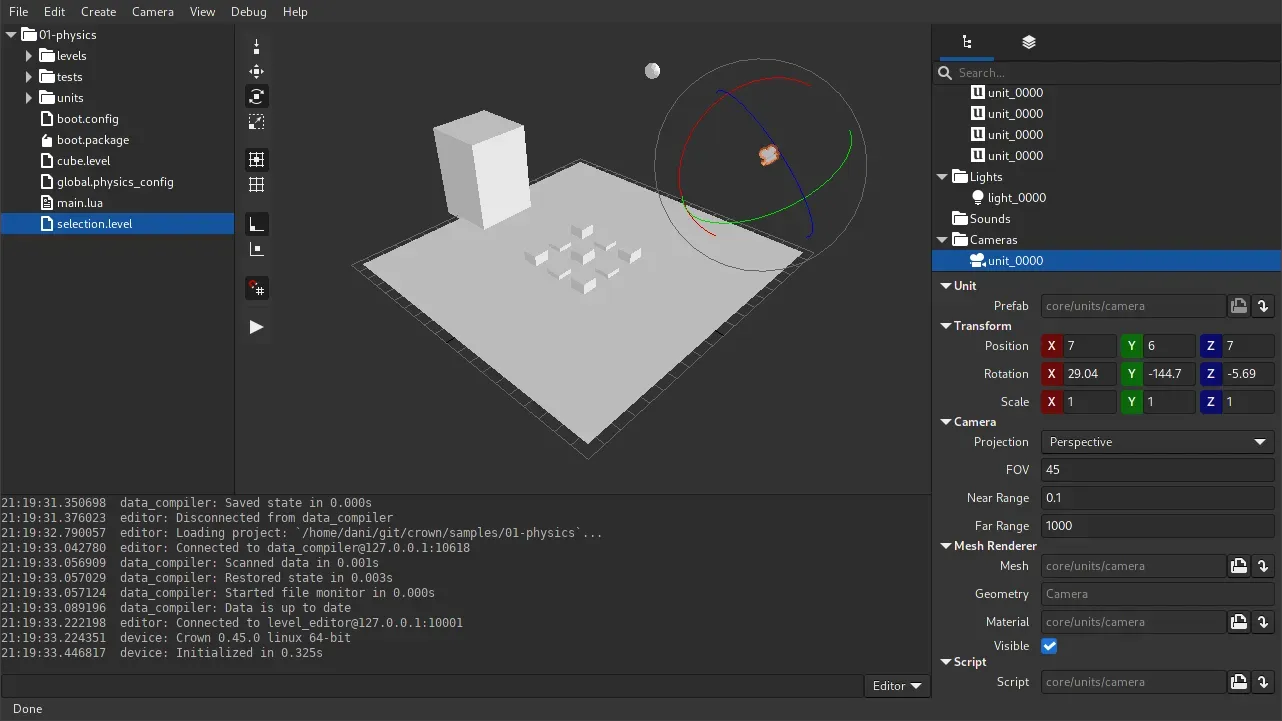
Key features include data-driven configuration, data-oriented memory organization, a lightweight codebase, cross-platform editing capabilities, and comprehensive support for graphics, animation, physics, audio, scripting, debugging, GUI, and input management. It’s designed for high performance across various platforms, including Android, Ubuntu, and Windows.
21. Spartan Engine
If you’re a beginner developer looking for learning and networking opportunities, this game engine in C++ is probably for you.
Spartan Engine is a research-focused game engine written in C++ designed for real-time solutions. Originally, it was not intended for game development, but for learning.
It offers exclusive perks like contributor recognition, networking opportunities with tech professionals, and learning resources, including an active Discord community and insightful YouTube videos. Spartan is about building a uniquely supportive community.
22. Cafu Engine
The
Cafu Engine
is a modern, open-source, all-purpose 3D graphics engine and game development kit. It supports the creation of a variety of 3D applications, including games, simulations, and training software.
Key features of Cafu Engine:
- High-quality, real-time 3D graphics, cross-platform support
- Dynamic lighting and shadows,
- Multi-player network support, and scripting with Lua.
- Ease of use and flexibility
23. Leadwerks
Leadwerks
is another C++ game engine for developers who want to learn. It offers the easiest path for beginners to evolve into proficient game developers. With its straightforward tutorials, no prior experience or knowledge is required to start building games.
Key features:
- Smooth Learning Curve
- Made for the PC
- Royalty-free License
24. RavEngine
The framework is a C++20 cross-platform game development tool designed to address common challenges in other game engines. It has innovative features, such as a fast Parallel ECS for efficient querying, multithreaded physics simulation, and 3D spatial audio with advanced reverb modeling.
Its rendering engine leverages modern APIs to support detailed graphics and lighting, complemented by a unique UI system inspired by web standards and includes comprehensive support for AR/VR, multiplayer networking, and a developer-friendly build process.
Significantly, it prioritizes ease of use and performance optimization, featuring automatic memory management through reference counting, eliminating the need for a garbage collector. Developers can directly author shaders in GLSL and utilize SVGs within the UI, enhancing the visual and interactive game elements.
The engine’s architecture also supports advanced animation blending, compute shader mesh skinning for efficient rendering, and programmable audio effects, ensuring a robust platform for creating immersive game experiences.
Conclusion
There’s no need to be concerned if you want to create digital games for consoles, PCs, or even mobile devices and need a game engine written in C++; once you know of these, you will take no time to implement your learning.
Every game engine has its own set of features and games that have been created so that you can see how the games are created in that engine. You can now create your games using the best Game Engines For C++ you learned about earlier.
Keep learning & practicing with InApps, your one-stop-shop for everything tech & development. Don’t miss out on recent updates, trends, and more.
4/5 - (4 votes)
Related Articles



Want to apply these insights?
Our AI architects offer free 45-minute consultations to discuss your specific use case.
Book a Discovery Call